

How to Adapt to an Aggressive Table in Live Poker Tournaments
Facing an aggressive table in a live tournament can feel uncomfortable even for seasoned players. Frequent raises, relentless three-bets and constant pressure after the flop quickly disrupt standard plans. Yet aggression is not chaos; it follows patterns. In 2026, with solver-influenced strategies filtering into live fields, understanding how to respond calmly and systematically is a crucial edge. The key is not to “fight fire with fire” blindly, but to identify where aggression is balanced, where it is excessive, and where it is driven by emotion rather than logic.
Recognising the Nature of Aggression at Your Table
The first adjustment is observational, not tactical. Live tournaments often feature different types of aggressive players: young regulars applying modern pressure with balanced ranges, experienced grinders exploiting tight amateurs, and recreational players overvaluing marginal hands. Each type requires a distinct response. Lumping them together as simply “aggressive” leads to costly misreads.
Pay attention to position and sizing. Is the player opening wide from the cut-off but tightening under the gun? Are their continuation bets consistent across board textures, or do they slow down on coordinated flops? In 2026, many competent players use smaller pre-flop opens and structured c-bet frequencies. Spotting deviations from these patterns helps you determine whether the aggression is technically sound or opportunistic.
Live tells remain relevant. Timing, chip handling, posture and eye contact still reveal confidence or discomfort. An aggressive player who suddenly hesitates on the turn may be running out of credible pressure cards. Combining technical reads with behavioural clues allows you to separate strategic aggression from emotional overextension.
Adjusting Your Opening and Calling Ranges
Against frequent three-bettors, tighten your early-position opens slightly and strengthen your continuing range. Marginal hands that perform well in passive games, such as suited connectors from middle position, lose value if you are forced to fold them to repeated pressure. Instead, prioritise hands that can comfortably continue versus re-raises.
From late position, however, you can widen selectively. Aggressive players often over-attack blinds but fail to defend properly when facing resistance. Introducing more four-bet bluffs with blockers, particularly against opponents who fold too often to re-raises, can restore balance. This is not about ego; it is about mathematically justified counter-pressure.
When calling three-bets in position, favour hands that realise equity well: suited broadways, medium pairs and suited aces. Avoid dominated holdings that create reverse implied odds. By refining pre-flop discipline, you reduce difficult post-flop spots and force aggressive opponents into clearer value-versus-bluff decisions.
Post-Flop Strategy Under Constant Pressure
On aggressive tables, pots grow quickly and decisions become expensive. The natural reaction is to “stand your ground” with medium-strength hands, but disciplined folding is often the higher EV choice. Ask whether your opponent’s line represents a coherent value range. If it does, respect it. If it does not, that is where controlled resistance begins.
Board texture matters more than ego. Dry flops such as K-7-2 rainbow offer fewer credible semi-bluffs than dynamic boards like J-10-9 with two suits. When an opponent barrels aggressively on static boards, their range becomes polarised. Understanding which runouts genuinely favour them allows you to pick more accurate bluff-catching spots.
Stack depth is equally critical. In tournaments, especially in 30–50 big blind situations common in mid-stages, one incorrect hero call can end your run. Adjust your threshold for stacking off. Against unbalanced aggression, calling down lighter may be profitable. Against competent pressure backed by equity, patience protects your tournament life.
Using Position and Pot Control Effectively
Position remains the single greatest antidote to aggression. When you act last, you gather information before committing chips. Against frequent c-bettors, consider floating in position on boards that favour your perceived range, then applying pressure on later streets if weakness appears. This shifts the dynamic without reckless escalation.
Pot control is not weakness; it is strategic restraint. Checking back medium-strength hands on the flop keeps ranges wider and prevents bloated pots where you are guessing. Aggressive opponents often expect resistance through betting. By varying tempo and occasionally declining to build the pot, you disrupt their rhythm.
Delayed aggression can be powerful. For example, checking back top pair on a dry flop and raising a safe turn can extract value while also protecting your checking range. Thoughtful sequencing prevents opponents from auto-firing without consequence and forces them to reconsider automatic continuation bets.
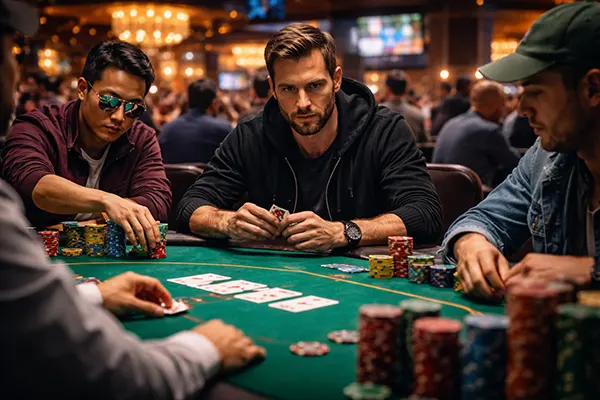
Mental Discipline and Table Image in Live Events
Aggressive environments test emotional stability. Repeated pressure may feel personal, but it is usually strategic. Maintaining composure is essential. Frustration leads to marginal four-bets, speculative calls and unnecessary confrontations. Professional discipline in 2026 still hinges on emotional control as much as technical knowledge.
Your table image evolves rapidly in live tournaments. If you fold consistently to early aggression, observant opponents will widen further. Conversely, one well-timed four-bet or check-raise can recalibrate perceptions. Strategic showdowns—where you reveal a strong hand after calling down—can discourage future bluffs without altering your core strategy.
Time management also plays a role. Use the available decision time to think through ranges rather than reacting impulsively. Live events provide physical space to slow the game down. Taking measured pauses communicates confidence and ensures your choices are deliberate rather than reactive.
When to Shift Gears and Reclaim Initiative
Adapting does not mean permanent defence. There are moments when shifting into controlled aggression is optimal. Target players who open too wide but fold excessively to resistance. Apply pressure near bubble stages, where ICM considerations make opponents risk-averse. Understanding tournament context sharpens your timing.
Reclaiming initiative often begins with selective three-bets from position. Focus on opponents who continuation bet frequently but struggle facing raises. Balanced aggression, supported by equity and blockers, restores equilibrium at the table. The objective is to challenge unsustainable pressure, not to gamble recklessly.
Ultimately, the best adjustment to an aggressive table is clarity. Identify patterns, refine ranges, protect stack depth and remain emotionally stable. Live tournaments reward those who observe before acting and who respond proportionally rather than impulsively. By combining structural awareness with mental discipline, you transform hostile dynamics into strategic opportunity.